- FNB Boston Newsletter
- Posts
- The Raised Carrot #003
The Raised Carrot #003
The Food Not Bombs Boston Newsletter

Food Not Bombs Boston
July 27, 2025

The Raised Carrot #003
The Food Not Bombs Boston Newsletter

Welcome back to The Raised Carrot! We’ve been keeping busy this summer, from events to emergency distributions of resources in response to heat waves. Malden Food Not Bombs has had a great first few serves every other Saturday for the last few weeks, and we’ve got exciting news about even more local chapters starting up! A new chapter in Quincy and Braintree just had their very first meeting last week. In honor of Disability Pride month one of our members wrote a personal piece about their experience with the healthcare system and we’re excited to share it with you.
If you want to help Food Not Bombs in any capacity don’t hesitate to reach out! Even if our usual serve days don’t work for you, you can join us on one of our unscheduled distributions during the week (we try to go out with cold water and supplies during heat emergencies!). If you can only help out from home then we appreciate you and we’ve got space making any kind of art, from graphic design to writing for this newsletter, or if you have another idea of a way you could help just let us know!
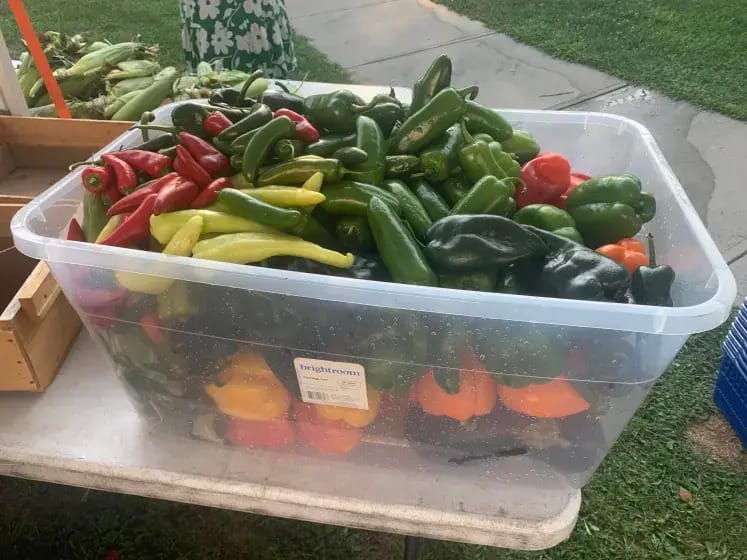
A generous (and colorful) donation of fresh produce
Table of Contents
Join Us For Our Free Meals All Around Boston

A cart of free drinks and popsicles for one of our heat wave distributions
There are a few Food Not Bombs chapters in the Boston area, come join us at one of them for a free meal! The best way to get involved with us is by coming to one of our serves. You can help us distribute food and goods or just enjoy a good meal and get to know us. There is no need to sign up in advance, and everyone is welcome! If you aren’t able to attend our serves then you can also send an email to your local chapter and ask what you can do to help out.
Boston Food Not Bombs serves a meal in Cambridge every Saturday 1-3 PM at James Cronin Park.
Email: [email protected] Instagram: @bostonfoodnotbombs Donate: ko-fi.com/food-not-bombs-boston
Roxbury Food Not Bombs - as of August 3rd, Roxbury Food Not Bombs will be moving to Dudley Square Plaza on Blue Hill Avenue, still serving every Sunday 1-3PM.
Email: [email protected] Instagram: @roxburyfoodnotbombs Donate: ko-fi.com/roxburyfnb
Waltham Food Not Bombs serves a meal in Waltham every Sunday 2-4 PM at Waltham Common, and also distributes free groceries every Wednesday 6 PM in a lot by 240 Moody Street.
Email: [email protected] Instagram: @foodnotbombswaltham Donate: Paypal [email protected]
Malden Food Not Bombs serves a meal every 1st and 3rd Saturday of the month at 1:30 PM right outside of Malden Center Station.
Email: [email protected] Instagram: @malden_fnb
Donate: ko-fi.com/fnbmalden
Somerville Food Not Bombs is coming soon!
Quincy and Braintree Food Not Bombs is coming soon!
Email: [email protected] Instagram: @foodnotbombs_quincybraintree
Events

At our tabling events we share free patches, zines, and more!
MIT Pride Festival - July 11th
We had a great time meeting folks at the MIT Pride Festival, watching some great performances and listening to some moving speeches. At our table we shared our usual array of patches, stickers and zines in addition to homemade cookies, muffins, and fruit salad.
Boston Blue Beat: Beach Episode 2025 - July 19th-20th
Boston Blue Beat is a 2-day video game festival and tournament series held each summer around Boston. This year’s Beach Episode featured anime fighting games and traditional fighting games in one of the biggest celebrations of fighting games in New England. The organizers ran an underwear donation drive for Food Not Bombs Boston and let us set up a table giving out patches, stickers and zines both days at the tournament.

MAMAS Free Store - August 9th
Look out for Food Not Bombs at the upcoming free store hosted by Mutual Aid Medford and Somerville on August 9th! The back to school free store runs from 10am to 2pm at the East Somerville Community School (50 Cross St), and will have free used clothing for all ages and sizes, as well as school supplies like calculators, notebooks, and pencils.
Needles, Stickers, and Microaggressions
A hospital is a hostile place, with bright fluorescent lights that hum softly yet eerily in a place that is as quiet as a funeral, despite being full of people (people die or come close to death in hospitals quite frequently, so I suppose that’s a fairly apt comparison).
Though everyone in a hospital is a human being outside of the hospital, while you are there, you are a patient. You are assigned a patient number (which is necessary because of the number of people who have ever seen a doctor). Attached to that number is a file in a vast database (Epic) and accessed through a portal that is only barely user-friendly (MyChart), though it’s certainly better than any other portal I’ve used. Epic knows just about every detail about my medical history before I do; I get the notification after it finds out that my incredibly structurally unsound body is having yet another problem. Some of these problems, like random anaphylaxis due to Mast Cell Activation Syndrome and neuromuscular respiratory weakness, are serious; however, a lot of these problems are benign in isolation. In medical terms, however, “benign” mostly just means it probably won’t kill you. I have myalgia, knee and jaw dislocations, autonomic nervous system dysfunction, a stomach that dumps things instead of digesting them, and more—which makes every problem a little less benign. This means that my chart looks like that of a hypochondriac, when it’s really that of someone who hasn’t felt physically OK since 2013. Even a healthy person gets sick sometimes, but sickness is my default state.
Usually, when I arrive at the hospital, the routine is about the same. I enter the waiting room and a receptionist (usually a woman or queer man between the ages of 25-40, and yes, I know, that is oddly specific) is waiting for me at a desk that is behind a glass or plastic shield. These shields became popular when COVID-19 began, because the American healthcare system did not think to put simple precautions in place before then. In Japan, it is considered normal to wear a mask in a medical setting; in America, we sit bare-faced in a room full of people who never learned how to cover their mouths when they cough and are at the doctor for said cough, filling the air with communicable disease when we could simply choose not to. I walk up to the desk and the receptionist and I pretend to be happy to see each other, giving each other a warm smile. They have been yelled at by more people than I even see on a typical day and I am fairly certain that I have developed medical post-traumatic stress disorder (which is quite common in medically complex patients). My hands are sweating and I’m feeling that deep dark feeling of doom, much like the time that I experienced what I believe was anaphylaxis in hindsight and was discharged with a diagnosis of “vertigo” before my mast cell activation syndrome diagnosis. We are both weary and trying to survive this system.
I am a person who has learned to instantly flip a switch and be charismatic. Being likable is a survival mechanism—sometimes, it is a survival mechanism in the most literal sense. A medical receptionist who doesn’t like you will be more likely to enter information incorrectly. A nurse who doesn’t like you won’t care as much if your vitals suddenly take a nosedive during an ER visit. A doctor who doesn’t like you is more likely to discharge you with a paper that tells you that maybe you should consider being less stressed. This was more of a problem before transition when I was still perceived as a woman—these days, I might get a 20th EKG as some sort of consolation prize. Because the receptionist usually likes me, they check me in quickly and don’t get upset when I ask for the sixth or seventh time for them to update my preferred name and pronouns on my chart. I see them try for a moment, but apparently, they still do not quite have this process down despite the number of trans people seeking medical care in the city of Boston.
They tell me to have a seat, so I go to the nearest chair with a mysterious stain on it, precariously leaning my crutches against it, knowing that they will likely fall. I watch instagram reels with the volume off and then play several levels of Royal Match (I have become quite good at Royal Match). Approximately 10-30 minutes after my scheduled appointment time, a medical assistant (also typically a woman or queer man of a slightly younger age range than the receptionists) calls me by the name that no one who I am on close or friendly terms with has called me since I was 19. They are looking for a young woman, but instead a stocky, hairy 200-lb man stands up and walks toward them. This creates a situation in which they are not sure if calling me “she” would be transphobic or progressive and I try not to think about it, but the palpable awkwardness of it demands both of our attention.
After we enter the doctor’s office, it’s business as usual. They ask me my name and then I must once again tell them the name that may as well be the name of a stranger at this point. They ask me for my date of birth, which I’m not even sure my best friend knows. I step on the scale when they ask me to and I’m still technically “obese” (according to my BMI, a random number made up by some guy before my grandfather was born). Because I don’t “look” like I’m “obese” to medical professionals due to my natural body type, I am fortunate enough that, typically, no one says anything about it. They then tell me to sit on The Table and I inevitably rip the thin white sheet of paper meant to keep it a little less unsanitary, exposing the cold vomitous pink (mauve?) vinyl under it. I apologize and they say “eh, it’s fine.” They take my blood pressure. Thankfully, my diastolic blood pressure is no longer as high as it used to be—when I had a problem with high blood pressure, my weight was a character flaw that I had to work on.
Eventually, the doctor walks in. The doctor is often a white man (though female doctors are becoming more common), which is in direct contrast with just about every other employee who keeps the hospital running. What happens next depends on the day. Last week, I got an EMG and nerve conduction study, which involved getting electrocuted by a woman who was angry that I wouldn't reschedule my appointment for an earlier time for half an hour. This was followed by a few minutes of getting my muscles poked with long needles by a neurologist with 44 years of experience who I could tell had a brilliant mind and kind heart but was somewhat lacking in social skills. He was the first person to note the contracture in my left knee and the laxity of my finger joints. My last EMG was unhelpful and I assumed there was a good chance that this would yield the same results, but I still clung to a shred of hope that the torture session wouldn’t be for nothing.
I don’t have a diagnosis yet and it’s something rare and confusing with traits of Ehlers-Danlos Syndrome and neuromuscular disease, as well as episodes that look sort of like a stroke and sort of like a migraine. This means that l am diagnosed with a psychogenic illness every couple of years until I develop respiratory weakness or joint contractures or something that looks kind of like a seizure but kind of like a migraine aura and they’re forced to reevaluate all over again. I have had to do my own research, which is how I’ve been diagnosed with most illnesses I have, and I’ve known for years now that my symptoms and comorbidities closely match Myopathic Ehlers-Danlos Syndrome (which is a type of Ehlers-Danlos Syndrome that has more neuromuscular involvement) and Hemiplegic Migraine. I cannot say this outright, however, unless I want another psych referral. I’ve been trying to decide if I should bring in a well-organized binder of research I have done on Myopathic Ehlers-Danlos Syndrome and Hemiplegic Migraine, or just keep waiting until the people with degrees that cost hundreds of thousands of dollars figure out what I’ve already figured out. I’m not sure how much longer I can stay silent and continue this endless death spiral. I’ve been leaning toward the former, as my survival and mental well-being are becoming more important than their egos. Sometimes, if I make up a fictional Friend Who’s a Nurse who had an idea about what it could be, I can get away with it, but I can’t count on it.
The betrayal can happen after the doctor acts like they’re listening. A pulmonologist that I started seeing about a year ago initially appropriately addressed my concerns and ordered a pulmonary function test. It showed that I have respiratory weakness. According to my research, my expiratory (breathing out) weakness is worse than my inspiratory (breathing in) weakness. I read several papers in prestigious medical journals about how expiratory weakness is often overlooked because it generally doesn’t affect oxygen levels, but it can cause serious problems such as pneumonia and nocturnal hypoventilation (not breathing well when sleeping due to respiratory muscle weakness). I read that nocturnal hypoventilation can happen even in the early stages of respiratory weakness and requires a BiPAP, which is a non-invasive ventilator—and emphatically NOT a CPAP, which just forces the airway open and doesn’t help you breathe out.
After I told my pulmonologist that I was waking up with my heart pounding and dizziness and headaches, he ordered a sleep study. They did not perform an arterial blood gas test which would show if I am retaining too much carbon dioxide—If I were, that would mean I have nocturnal hypoventilation. When I expressed concern, I was told it wasn’t “bad enough yet,” despite everything I had read quite clearly stating that a BiPAP is the more appropriate choice in a patient with neuromuscular respiratory weakness. Apparently, they will refuse to give me one until I “fail” the CPAP (as if the CPAP were a test that I should have studied for). Recently, a respiratory therapist came to set up my CPAP. He mocked me for trying to express my concern about using a CPAP with a neuromuscular condition that causes respiratory weakness, then shoved the CPAP mask onto my face. I told him that I could not resist the forced airflow and breathe out; I was told that I should “just relax” and that it was normal. I suppose that I will have to wear a CPAP for 4 hours a night for 21 days and be unable to breathe until my prolonged insurance-mandated torture is over, which sounds dangerous to me—but I’m not the one with a medical degree.
Though hospitals are supposed to be places of healing, they inflict as many wounds as they treat, and I have never met a medically complex person who has disagreed with this. There is the life I live outside of the hospital in which I am intelligent, funny, generous, friendly, and creative. There is the life I live within the hospital, in which I am treated as an unreliable narrator who knows nothing. My life is in the hands of a person who hasn’t had a full night’s sleep in weeks and only has about 15 minutes to spare. I am spoken to as if being disabled is a choice that I have made (consciously or subconsciously) by a person who was able-bodied enough to survive medical school and graduate summer cum laude or whatever they call it. These doctors are as human as I am, but we both must pay the price of pretending they are above human error. The number of medical professionals who have seen and touched my unclothed body far outnumbers the number of people I have slept with. After I have been stripped, covered in stickers and wires, electrocuted, poked with needles, and invalidated to a degree that would be considered gaslighting in any other interpersonal relationship, I am sent home like I wasn’t just subjected to some sort of humiliation ritual or torture session. Every time we talk about “health care reform,” I wonder how we can reform a system that upholds the objectification and dehumanization of marginalized bodies, reinforcing deeply ingrained societal power dynamics in the provider-patient relationship. Every hospital that I have been to functions on the unforgiving, poorly compensated, and mostly invisible labor of marginalized people—particularly women, queer people, non-white people, and especially those who are at the intersection. I find it hard to believe that more DEI training or pronoun buttons will fix the glaring inequities and inherent violence it is built upon. The medical system is not trauma-informed—and therefore does not fully comprehend the trauma it inflicts upon its patients and employees.

A cart of clothes donations for distributing to our neighbors
Support Food Not Bombs Boston
All of the food, clothes, and supplies that we are able to share with our neighbors come from donations. If you have anything you can donate to help us out you can send us an email or DM our Instagram! We also use financial donations to fund purchasing high demand items like underwear, socks and soap. If you are able to give, we would greatly appreciate a monthly or one-time donation.

Check out Malden Food Not Bombs!
Hello! We are Food Not Bombs Malden, a new chapter in the area! Many of our current members are branching out from chapters in the Boston area. We realized we were all riding the orange line across town when we could be doing some mutual aid goodness closer to home.
We serve fresh food on the first and third Saturdays of every month. You can find us near the circle of benches at the corner of Commercial and Pleasant streets, right outside of Malden Center Station. If you are interested in joining us for a free meal, we hope to see you there. If you have resources to share or want to help out, email us at [email protected].
Our organizing objectives are similar to other chapters: build community through food so we have the strength to resist another day. We’re especially excited to invite people to shape what good food for the community means and support other groups doing cool, bottom-up work in Malden. If you have ideas, come and find us at Malden Center!
Also check out Roxbury Food Not Bombs

Roxbury Food Not Bombs is a younger sister organization of Boston Food Not Bombs, for folks south of the Charles River. Since October 2024, we’ve served vegan food for our neighbors, as well as distributing clothes, harm reduction materials, and literature. Like Boston FNB, we are not a charity where the rich give to the poor, we are a mutual aid organization standing in solidarity with, and providing for, all who have been harmed by capitalism and our government.
If you want to get involved, coming to our serve is the best way to get started – there is no need to sign up, you are welcome to just show up! Right now, Roxbury Food Not Bombs serves Sunday 1-3 PM in Justice Edward O. Gourdin Veterans Memorial Park. As of August 3rd, Roxbury Food Not Bombs will be moving to Dudley Square Plaza on Blue Hill Avenue, still serving every Sunday 1-3PM.
Follow what we’re doing on Instagram at @roxburyfoodnotbombs or email us at [email protected]. You can make a one-time or recurring donation on ko-fi. We also appreciate donations of vegan food, clothing, and hygiene supplies.
Links
